
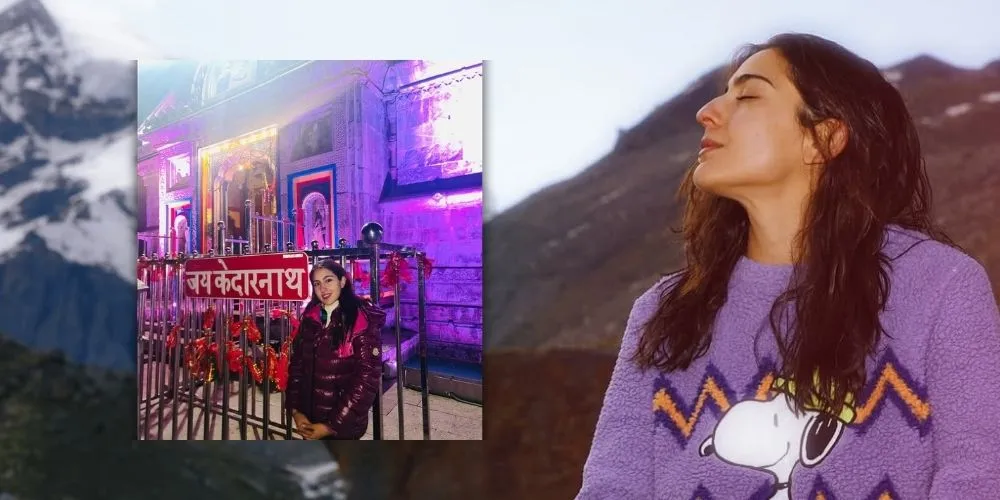
In a move that has sparked intense debate across religious and cinematic circles, the Badri-Kedar Temple Committee (BKTC) has introduced a stringent new protocol for non-Hindu devotees wishing to offer prayers at the Himalayan shrines. At the center of this burgeoning controversy is Bollywood actress Sara Ali Khan, who must now reportedly submit a formal affidavit proving her homage to Sanatan Dharma if she wishes to continue her annual pilgrimage to Kedarnath and Badrinath.
The announcement comes directly from Hemant Dwivedi, Chairman of the Badri-Kedar Temple Committee. In a formal address, Dwivedi emphasized that the sanctity of the “Dhams” remains paramount and that visitors from diverse religious backgrounds must now explicitly declare their faith in the tenets of Sanatan Dharma before crossing the temple thresholds.
The BKTC’s decision introduces a structural shift in how the shrines manage high-profile and international visitors. Under the new guidelines, any individual identifying as a non-Hindu must provide a legal affidavit. This document must express a sincere faith in Sanatan Dharma and a commitment to following the traditional rituals and codes of conduct prescribed by the temple priests.
“We welcome everyone who has genuine faith,” Hemant Dwivedi stated. “However, to maintain the spiritual vibrations and traditional integrity of Kedarnath and Badrinath, non-Hindu devotees will now be required to provide proof expressing faith in Sanatan Dharma. This is not about exclusion, but about ensuring that those who enter the sanctum sanctorum do so with the correct spiritual alignment.”
The timing of this mandate specifically highlights Sara Ali Khan’s deep-rooted connection to the region. Sara’s relationship with the Kedarnath temple began in 2017 during the filming of her debut movie, Kedarnath with Sushant Singh Rajput. Since the film’s release, the actress has transformed into a “regular” at the shrine, often sharing images of her trekking through the snow and participating in elaborate Aartis.
For nearly a decade, Sara has travelled to the shrines every year, regardless of her filming schedule. Her social media posts often feature the “Har Har Mahadev” chant, showcasing what many perceived as a sincere personal devotion. However, due to her interfaith background, she now falls under the purview of the BKTC’s new “Allegiance Clause.”
The directive has polarized public opinion. Supporters of the BKTC argue that the Kedarnath and Badrinath temples are not mere tourist destinations but “Jagrit” (awakened) spiritual centers that require a specific level of religious discipline. They believe the affidavit ensures that visitors treat the deity with the respect dictated by ancient scriptures.
On the other hand, critics argue that such mandates could hinder the universal appeal of Indian spirituality. Sara Ali Khan’s fans have been particularly vocal, pointing out that her consistent presence at the temple over the years should serve as sufficient proof of her devotion. The requirement for a legal document to “prove” faith has been described by some as an unnecessary bureaucratic hurdle for a private matter of the heart.
Chairman Hemant Dwivedi remains firm in his stance. He noted that the committee had observed instances where the sanctity of the temple was compromised by those who viewed the pilgrimage as a lifestyle trend rather than a religious duty.
“The shrines are the pillars of Sanatan Dharma,” Dwivedi remarked. “When a devotee like Sara Ali Khan or any other public figure visits, they influence millions. We want that influence to be rooted in a documented commitment to our traditions. If the faith is real, an affidavit is merely a formal expression of that truth.”
As we move further into the 2026 pilgrimage season, industry experts expect other temples in the Char Dham circuit to monitor the impact of this decision. If the BKTC successfully implements the affidavit system, it could set a precedent for other major religious sites across India, such as Varanasi or Puri.
For Sara Ali Khan, the next move remains to be seen. Given her vocal love for the mountains and the deity, many expect her to comply with the regulations to continue her yearly tradition. However, the move has certainly added a layer of legal complexity to what was once a simple journey of faith.
The requirement for a faith-based affidavit marks a new era for the Uttarakhand pilgrimages. Whether this move preserves the sanctity of the shrines or creates a barrier for the devout remains a subject of heated national conversation. As the 2026 season peaks, all eyes will be on the Kedarnath gates to see how the “Allegiance to Sanatan Dharma” rule is enforced.