
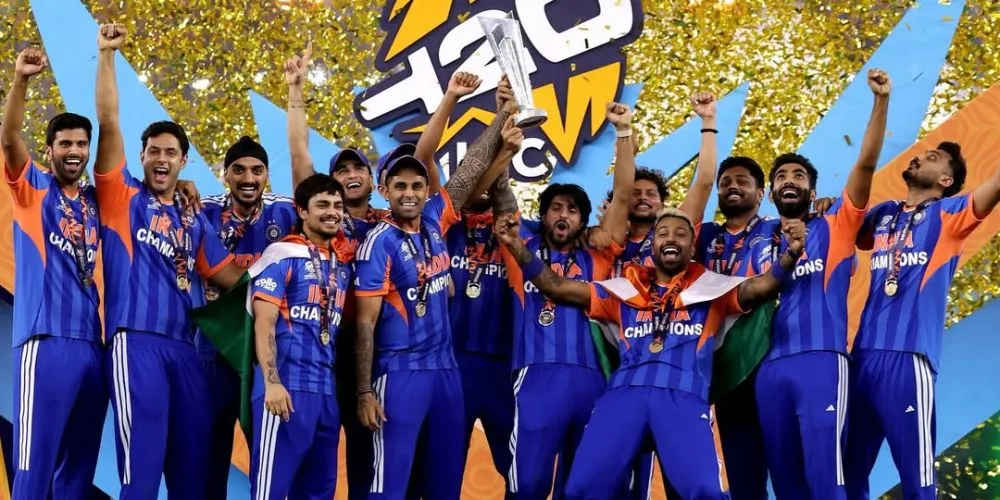
History didn’t just repeat itself; it was rewritten in bold, blue ink. In a display of pure cricketing dominance, India clinched the ICC T20 World Cup 2026 title, defeating New Zealand in a high-octane final. This victory marks India’s third T20 World Cup title and, more impressively, their second consecutive win following their 2024 triumph.
The world witnessed a tactical masterclass and a batting explosion that left the Black Caps reeling. From the moment the first ball was bowled, India played with the “champion’s arrogance,” proving that the trophy belongs in the subcontinent.
Under the swirling clouds of the final venue, New Zealand won the toss and elected to bowl first. Captain Mitchell Santner hoped the early moisture would assist his pacers, aiming to stifle the Indian openers before they could settle. It was a traditional move, but on this day, tradition stood no chance against the “New India” brand of aggressive cricket.
India’s captain stood unfazed at the toss. With a deep batting lineup and a thirst for a “three-peat” narrative, the Men in Blue welcomed the chance to set a target. What followed was not just an innings; it was a 120-ball blitzkrieg.
India didn’t just bat; they hunted. The scoreboard at the end of 20 overs read a staggering 255 runs, a total that felt more like a video game score than a World Cup final tally.
The onslaught began with Abhishek Sharma, whose fearless approach at the top of the order dismantled the Kiwi opening spell. Alongside him, Sanju Samson played a “fiery” innings that will be talked about for decades. Samson’s ability to find gaps and clear the ropes with minimal effort turned the middle overs into a boundary-counting exercise for the spectators.
- Abhishek Sharma: Provided the lightning-fast start with a flurry of sixes over point.
- Sanju Samson: Anchored and accelerated, proving why he is the most dangerous opener batter in the world today.
- Ishan Kishan: Brought his trademark energy, finding angles that frustrated the New Zealand spinners.
- Shivam Dube: Provided the finishing touch, launching the ball into the stands with a brute force that left the fielders as mere spectators.
By the time the 20th over concluded, the New Zealand bowlers looked shell-shocked. A target of 256 in a final is a mountain most teams wouldn’t even dare to climb.
Chasing a record-breaking total in a ICC T20 World Cup final requires a perfect start, but the Black Caps found only chaos. The Indian bowling attack, led by the incomparable Jasprit Bumrah, sensed blood in the water.
Bumrah’s “attacking” bowling was a sight to behold. He moved the ball both ways, late and with venomous pace. Every time a New Zealand batter looked to accelerate, Bumrah or his cohorts found a way to break the partnership. The Black Caps struggled to find any rhythm, losing wickets at regular intervals as the required run rate climbed into the stratosphere.
While the bowlers did their job, Ishan Kishan turned the game into a personal highlight reel in the field. Often overshadowed by his batting, Kishan’s “fantastic fielding” resulted in two crucial run-outs and a diving catch at the boundary that defied the laws of physics. His energy was infectious, ensuring that India never took their foot off the gas even when the result seemed certain.
New Zealand eventually folded for 159 runs in 19 overs. The 96-run victory margin is one of the largest in the history of ICC finals, underscoring the gap between India and the rest of the world.
This victory cements India’s status as the undisputed kings of the T20 format.
Winning back-to-back titles (2024 and 2026) is a feat that speaks to the incredible depth of Indian cricket. The transition from the legends of the past to the superstars of today—Samson, Abhishek, and Kishan—has been seamless.
As Jasprit Bumrah claimed the final wicket, the celebrations began from Barbados to Bengaluru. India has once again proven that when it comes to the shortest format of the game, they are the gold standard. With three trophies now in the cabinet and a young team that seems to only get better, the world of cricket has been put on notice: The era of Indian dominance is here to stay.